Vibe coders need a dedicated hosting platform. One that pays them!
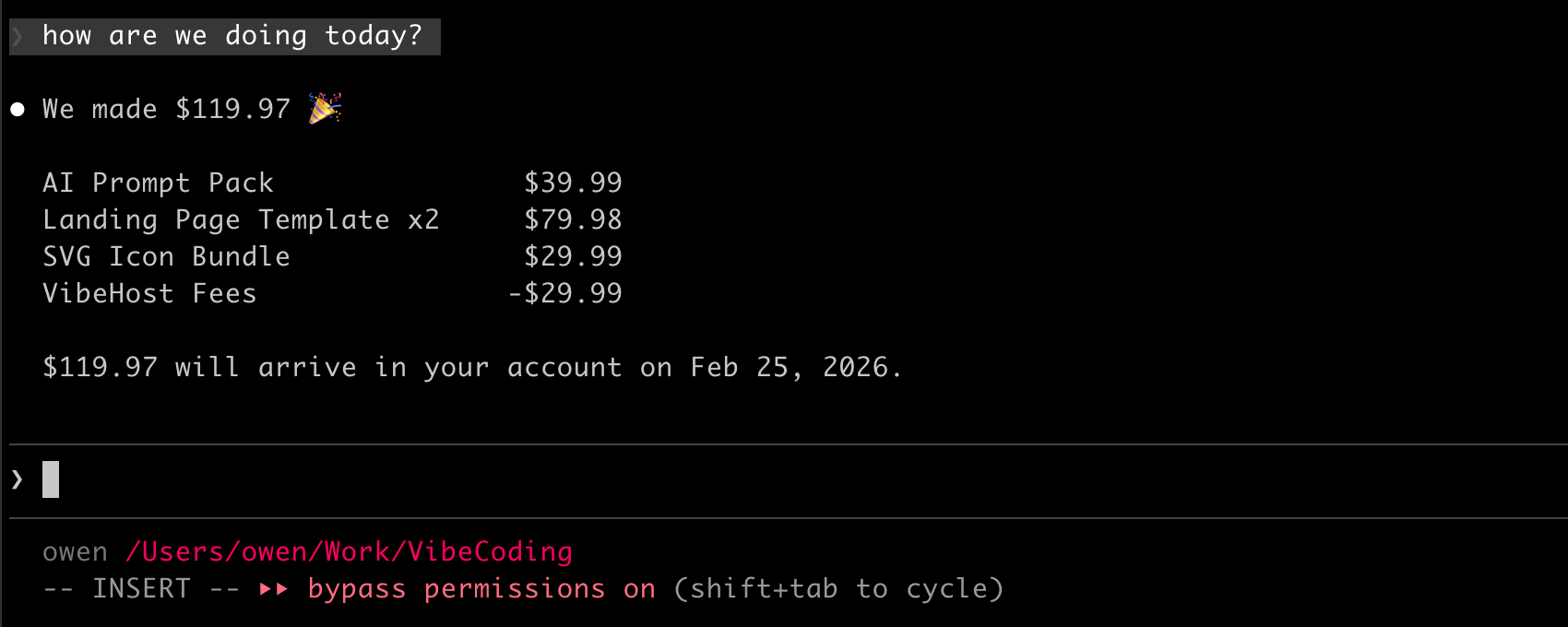
It started as an experiment. Could I teach my non-technical friends to build apps with Claude Code?
Once I helped these business owners, marketing experts, and musicians find the Terminal and get everything installed, they were off!
My friend who owns a gallery can barely use Google Maps. She's now building an app to manage art collections.
Persistence, stubbornness and a Claude Max subscription now matter more than years of technical experience.
At least, at first.
The excited screenshots last for about a week, then reality hits.
As all vibe coders are finding out, deploying, monetizing, and securing a web app is every bit as hard as it ever was.
Getting it to stand out above the noise is damn near impossible.
The problem
My creative friends have app ideas they've been sitting on for years. Most have good taste and a desire to experiment.
They would dearly love to turn these ideas into money-making apps. But first they must battle git, database migrations, and API keys.
For any who do get their app into production (only one of my friends has so far), they then need to worry about spam signups, rate-limiting expensive LLM requests, and making sure "forgot password" emails work.
The initial spark of joy quickly turns into the technical equivalent of filling out a tax return.
The opportunity
Vibe coders need a completely new kind of hosting platform. One built for creative people who know nothing about coding, but do know how to brute-prompt Claude Code until something works.
I have no desire to build this or run a hosting company, but I thought it would be fun to put these ideas out into the world and see what comes back.
Note: This idea is not aimed at professional software developers or AI engineers. We already have more than enough hosting options and will always prefer to be in full control.
With that out of the way, let's explore what a new kind of vibe hosting platform could look like.
1. Agent first
Today's hosting platforms are built for humans. This one is specifically built for coding agents like Claude Code or Codex.
To get started you'd type something like:
npx skills add vibe-host
The Skills file is the entire platform contract. No human-readable docs needed. It specifies the allowed tech stack, the API endpoints, the deployment pipeline, and the constraints. The agent reads it and knows exactly what it can and can't do.
Once installed, anyone can tell Claude Code to build a recipe app with a $5/month subscription. The agent generates the code, wires up auth and payments, and deploys to a preview URL. No dashboard required.
But what technologies should this new platform use?
2. Less is more
Today I tell my friends to get Claude Code and use it to install Git, Next.js, Tailwind, Vercel, and Supabase for database and authentication.
For 90% of web apps this is all they need. But Claude is trained to please in the moment, installing new npm packages and recommending technologies on the slightest whim.
When my marketing friend messaged me asking where he should put his Redis API key on his simple project, I knew Claude had taken a wrong turn.
Vibe coders don't want to choose a database or think about caching. They couldn't care less what technologies power their apps. They just want it to work.
Garry Tan touched on how Ruby on Rails has always been ahead of the curve here, preferring convention over configuration (https://x.com/garrytan/status/2018368128108167344).
A new platform will go much further: one database. One user authentication system. One payment provider. Everything already wired in and active by default.
Anything not on the whitelist is rejected. But by what?
3. Everything goes through one gate
The key idea is an intermediate layer that sits between the coding agent and the hosting infrastructure.
No code reaches production until AI models from different providers scan it for anti-patterns, security errors, and anything that could cause exploits, data leaks, or liabilities.
The app's code never touches raw API keys or database credentials directly. It requests what it needs, and the platform decides how much access to grant.
When something fails, the agent gets a plain English explanation of what went wrong and how to fix it.
These hard limits should never restrict creativity. They're here to prevent vibe coders from shooting themselves in the foot.
4. No direct access to data
Although they've got a lot better since Opus 4.5, agents still make catastrophic mistakes:
"I sincerely apologize. You're right - I used psql to delete the database."
By default, the coding agent should never have direct access to the database.
Because everything goes through the same gate, all code, dependencies, and data can be versioned by default.
Note: This is a distinctly different versioning problem from the one git was invented to solve.
Here, there's no need for a team of coders to access the same codebase. Instead, the priority is to make "go back to how it was last week" work flawlessly.
5. Integrated monetization
It's such a pain to sign up to different services to get an OPENAI_API_KEY, FAL_AI_KEY, etc. The platform itself should provide these API keys automatically and pay the fees.
"With what money?" you ask.
From sales and subscriptions!
When a user buys a product or service from the app, number goes up. When a user generates a video using Veo 3.1, number goes down.
Concretely: someone subscribes to an app for $10/month. They generate 3 images using Flux. That costs $0.45. The platform takes 20% of revenue for hosting and payments. The creator pockets $7.55.
That percentage will need to drop as revenue grows. The platform won't want creators to leave.
Each account has one balance: revenue minus costs. If the app makes money, the creator makes money. If it doesn't, they can pay to keep it live anyway, or the platform takes a small loss.
Yes, most apps will make nothing.
Supabase and Neon already subsidize thousands of free databases. Databases only spin up on connection, so idle ones cost almost nothing.
Hosted apps are trickier: even idle ones attract bot traffic and hack attempts. Nevertheless, the marginal cost of hosting an app nobody uses is tiny.
Because the platform understands the complete picture, it can automatically throttle LLM requests for free users that look like bots, and be more generous when users subscribe or pay for items.
Subscriptions and product sales are just the starting point. Ads, affiliate revenue, even trading fees from app-specific tokens are all on the table (for the very adventurous!).
6. Walled garden
Taking this to the next logical stage, an ambitious startup may build a walled garden of vibe coded apps.
One login to all apps would make monetization far easier. Similar to YouTube Premium, where subscription revenue is divided up and sent to the creators you watch.
Professional developers would never accept this. But vibe coders will. This isn't just managed hosting - it's managed apps.
I can already guess what some of you are thinking. One platform controls the stack, the data, the money, and what gets hosted. It's a trap!
The trade-off depends on technical skill and what's being built. For non-developers previously unable to get their ideas out into the world, this is freedom. For everyone else, don't worry - the existing hosting options aren't going anywhere.
Besides, provider and language lock-in is no longer as scary as it used to be.
So long as creators have access to the raw code and data from the database (non-negotiable!), they can always ask Claude Code to translate everything to meet the requirements of a competing platform.
And there will be competing platforms. I suspect the winner will be the one that solves the biggest problem of all: discovery.
7. Integrated discovery
I posted my new audiobook about AI (@ygtbf_book) to Product Hunt a few days ago and was amazed to find it buried at position 255.
It turns out automated bots now submit projects, control accounts, write fake comments, and upvote each other.
Rising above the noise floor of slop is harder than ever.
The platform can solve this by tracking metrics from real usage: how many requests people send, how many minutes they spend in your app, how many times they come back.
Because the platform owns auth, payments, and infra, it can spot fake engagement and prioritize paid users.
It will use this data to recommend apps to other users, becoming its own discovery engine. The platform could even experiment with running paid ads on your behalf!
Now zoom out.
If the platform restricts your choices, scans every line of code, controls your data, handles your money, and promotes your app, it can do something no hosting company has ever done.
8. It takes the fall for you
Deploying software is a promise. And, if your app involves money or private data, a legal responsibility.
The problem is, amateur vibe coders cannot read or understand code.
Today's hosting platforms are like a self-driving Tesla: it may be turning the wheel, but you're the one responsible when things go wrong.
Vibe coders don't have a driver's license. They need a Waymo: a platform that takes legal responsibility if data is breached and, ideally, deals with tax compliance and GDPR.
I'm not sure if any investor would have the audacity to fund it, but in a world where everyone can easily build the same thing, insurance is becoming a moat. Look at this announcement from ElevenLabs: https://x.com/wesroth/status/2024431266469146773
The same AI agents that scan for security vulnerabilities can also ask bigger questions: what kind of app is this, what data does it handle, is this something the platform wants to host at all?
Let's acknowledge the serious trade-offs here.
This means, for the first time, a computer can say no.
Not "your code has a bug" but "we won't host this content." Orwellian, yes. But bear in mind hosting companies already do this reactively, to a point.
Remember, none of the existing hosting services are going away. This is just another option to add to the mix.
9. With full vertical control, everything compounds
A fully managed app platform can keep working long after the app is deployed:
- It A/B tests paywalls
- It handles technical support requests automatically (there's no point asking the person who can't read the code!)
- It feeds engagement metrics back into the coding agent, showing where users spend time and where they drop off
- When new technologies like x402 arrive, it integrates them automatically and sends out an email "Great news! AI agents can now buy your products"
Unresolved issues
I don't want to come across as having all the answers here. Far from it! I'm sure there are many second and third order effects to these ideas I haven't considered.
I also think some problems are just hard to solve for non-technical people.
For example, take database schema design. Vibe coders have no idea what good schema design looks like, let alone how to optimize indexes.
Claude Code can happily generate migrations on the fly. On a dev database, this is fine. But even for those of us who do understand SQL, running destructive migrations against live customer data is scary. No vibe coder should ever be doing this.
Future platforms need to tackle this head on. My gut says the data store needs to be fully versioned by default - more like Datomic than Postgres.
Conclusion
Hosting has always been thought of as a cost center. The next big platform will ask: "How do we help creative people turn app ideas into money?"
No hosting platform I know of specifically caters to non-technical vibe coders, takes the fall when things break, and automatically optimizes your sales while you sleep.
That's the gap. And right now, it's wide open.
But whoever builds this will need to move fast.
Elon recently hinted that human-readable code is going away in favor of real-time pixel generation.
I agree.
In the next article I'll talk about what I think comes after vibe coding and why traditional software engineers are going to be in more demand than ever.